Storage Trailer Rental: Costs and When It Beats Warehouse Space

20 Nov 2026
How storage trailer rental works, what drives the cost, and when a trailer parked at your dock makes more sense than more warehouse space.
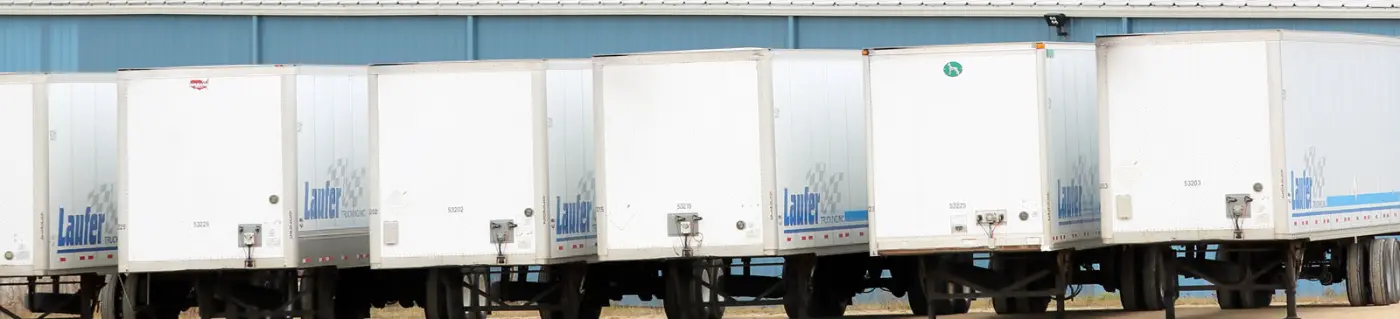
Floor space never runs out at a convenient time. A new production line arrives before the old stock ships, a renovation takes over half the warehouse, or the season's inventory lands all at once. Storage trailer rental is often the fastest way to buy back room, because the space arrives on wheels and parks right at your dock.
Before you rent a storage trailer, it pays to know how the rental works from drop-off to pickup, what drives the cost, and when a trailer is the wrong answer altogether.
What is a storage trailer?
A storage trailer is a semi-trailer, usually a dry van, that sits on a customer's property to hold excess inventory. It isn't hauling freight while it's there. It's simply extra space, in a box that's dry, lockable and already built to take pallets.
Most storage trailers are 48 or 53 feet long. A 53-foot dry van holds 26 standard 48 x 40 pallets in a single layer, with 100 inches of usable width and 110 inches of usable interior height, though freight should not be higher than about 105 inches so it clears the dock plate. Because a trailer sits at dock height, it loads straight from a dock door with a pallet jack or forklift, the same way any truck would.
Storage trailer vs drop trailer
The two get mixed up, but they do different jobs. A storage trailer stays put and holds your inventory. A drop trailer moves as part of a regular freight rotation: it's loaded at your dock, then pulled and replaced on a schedule. That's what a drop trailer program is, and the swap itself is how drop and hook trucking works. If the trailer is meant to leave full and come back empty, it's a drop trailer. If it's meant to sit there and hold stock, it's a storage trailer.
Storage trailer vs storage container
A shipping container sits on the ground, so loading it means a ramp or a forklift that can drive in. A storage trailer sits at dock height, so it works with a loading dock. Containers suit sites without a dock. Trailers suit warehouses and plants that already load trucks every day.
How storage trailer rental works
Storage trailer rental means a trucking company parks one of its trailers at your site as extra storage space, billed by the week or the month for as long as it stays. You load and unload it yourself, and the carrier collects it when the project ends. Renting one runs in four steps:
- Check availability. Storage trailers may be older trailers that are retired from the road, or they may be trailers that a carrier actively uses for hauling freight. What a carrier such as Laufer has available can change by the day based on customers' storage needs. Sometimes a storage trailer can be available the day of the request, other times it may take weeks for a trailer to become available.
- Drop. The carrier delivers the trailer and parks it where you need it. There's usually a fee to drop it at the start of the project.
- Use it. You load and unload it on your own schedule. The rental is billed weekly or monthly for as long as it stays.
- Pull. When the project ends, the carrier collects the trailer, and there's usually a fee to pull it out.
Stationary or roadworthy
Not every storage trailer is the same kind of trailer. Older trailers placed purely for storage shouldn't be expected to move once they're parked. Newer trailers that are still roadworthy can move between locations as your needs change. Laufer can also hold loaded trailers at its Hartford terminal until you're ready for them, which frees up yard space at your end. It's all part of Laufer's storage trailer program.
How much does it cost to rent a storage trailer?
Storage trailer rental cost has three parts: a weekly or monthly rate while the trailer is on your site, a fee to drop it at the start, and a fee to pull it at the end. The rate itself depends mostly on the trailer, what you need it for, and how far away the customer is from the trailer's origin.
- Age and condition. Older 48-foot trailers placed for storage are typically the least expensive, because they're not expected to move again once they're parked. A newer trailer in good enough condition to still be roadworthy is charged at a higher rate.
- What you need it for. A trailer that just has to hold stock in one spot costs less than one that needs to stay road-ready to move between sites.
- How long you keep it. A trailer billed by the month for a long project will have a different rate than a trailer that is needed for only a week or two.
- Getting it there and back. The drop and pull fees cover delivering and collecting the trailer, so they're charged once each, not every month.
When you compare quotes for storage trailers to rent, add the two one-off fees to the rate for the time you expect to keep it. A low weekly rate with steep drop and pull fees can cost more over a short project than a slightly higher rate with lighter ones.
When a storage trailer beats warehouse space
Most businesses rent storage trailers for one reason: they've run out of floor space. A trailer adds room right where the work happens, without a lease, a move or a second building. It makes the most sense when the need has an end date:
- Overflow. Inventory has outgrown the building, and the floor is needed for production.
- Seasonal stock. Product is built or bought ahead of a busy season and has to sit somewhere until it ships.
- Special projects. A renovation, or a new production line being installed, takes over floor space for a few weeks or months.
- Unneeded goods. Items that may not be currently needed for anything, but the business does not yet want to discard.
When it doesn't
A storage trailer is the wrong answer for inventory that moves often. Warehouse space with racking, staff and inventory control usually serves better. Storage trailers also aren't climate-controlled, so anything that can't take Wisconsin's summer heat or winter cold belongs somewhere else. And a site with no room to park a 53-foot trailer, or no firm ground to park it on, rules one out before cost comes into it.
Placing a storage trailer on your site
A few things are worth sorting out before the trailer arrives:
- Space to get it in. A tractor has to back the trailer into place, so you need room for a 53-foot trailer plus the space to maneuver it.
- Firm ground. A loaded trailer rests on its landing gear, and on soft ground or thin asphalt the legs can sink or leave damage. Concrete, or well-built blacktop, is the safe spot. A concrete pad under the landing gear helps for a long stay. There are devices that can be used to help support dropped trailers, or wood or other solid items that can be placed under the dolly legs.
- Access. Parked at a dock door, the trailer loads like any truck. Away from a dock, you'll need a ramp or a forklift that can reach in.
- Security. What goes in the trailer is your call. As long as you're comfortable that it's a safe and secure place for it, you're free to use it as you need. A good padlock on the doors, and a spot that's lit and in view, go a long way.
- Local rules. Some towns and business parks limit how long a trailer can sit on a property, so it's worth a quick check before you commit to a long rental.
Rent a storage trailer from Laufer
Laufer Trucking is a family-owned, asset-based carrier in Hartford, Wisconsin, running since 1977. Our storage trailers come out of our own fleet, which is why availability changes, and why the honest first step is always the same: contact us for availability.
Call Laufer at (262) 673-6810 with how long you need the trailer, what you'll keep in it and where it's going. We'll tell you what we have, whether a stationary or roadworthy trailer suits the job, and what the drop, pull and rental will cost. If you'd rather put it in writing, you can request a storage trailer quote online.
Frequently Asked Questions
It depends on the trailer and the job. Storage trailer rental is usually billed weekly or monthly, plus a one-off fee to drop the trailer and another to pull it. Older trailers placed for storage only are typically the cheapest. Newer, roadworthy trailers that can move between sites cost more.
As long as the project needs it. Rentals are billed by the week or the month, so a trailer can stay for a few weeks during a renovation or several months through a busy season. For a permanent need or frequently rotating stock, warehouse space is usually the better fit.
It depends on what's available. Storage trailers come out of a carrier's working fleet, so sometimes one can go out the same day and sometimes it takes weeks. Calling ahead, especially before a seasonal rush, gives you the best chance of getting one when you need it.
A storage trailer stays on your property to hold excess inventory. A drop trailer is part of a regular freight rotation: it's loaded at your dock, then pulled and swapped for another on a schedule. One is extra space. The other is a way of shipping freight without a truck waiting at the dock.
Typically, yes. Older trailers placed for stationary storage shouldn't be expected to move again. Newer trailers that are still roadworthy can be moved between locations as your needs change, which is worth asking for if you might need the space somewhere else later.
Generally whatever you're comfortable keeping there, as long as it's a safe and secure choice for the goods. Keep in mind that a dry van storage trailer isn't heated or cooled, so it suits stock that can handle the temperature swings of a Wisconsin summer and winter.
For a business with a loading dock, usually yes. A storage trailer sits at dock height and loads straight from a dock door with a pallet jack or forklift. A shipping container sits on the ground, which suits sites without a dock but means using a ramp or a forklift that can drive in.
A 53-foot trailer holds 26 standard 48 x 40 pallets in a single layer, with more if the pallets can be stacked. A 48-foot trailer holds fewer. The usable floor, not just the length, sets the real number, so measure what you plan to store before you rent.
Sometimes. Rules vary by town, and some municipalities or business parks limit how long a trailer can sit on a property or where it can be parked. A quick call to your local zoning office before a long rental avoids a surprise.
For short-term needs, it often is, because there's no lease, no move and no second building. The space is also right at your dock, so there's no trucking stock back and forth. For a need that lasts year-round, the comparison shifts toward warehouse space.