How Many Pallets Fit in a 53’ Trailer?

26 Aug 2026
A 53’ dry van holds 26 standard 48-by-40-inch pallets in a single floor layer, loaded straight. Turning the pallets can raise that up to 30 and a pinwheel pattern reaches 28.
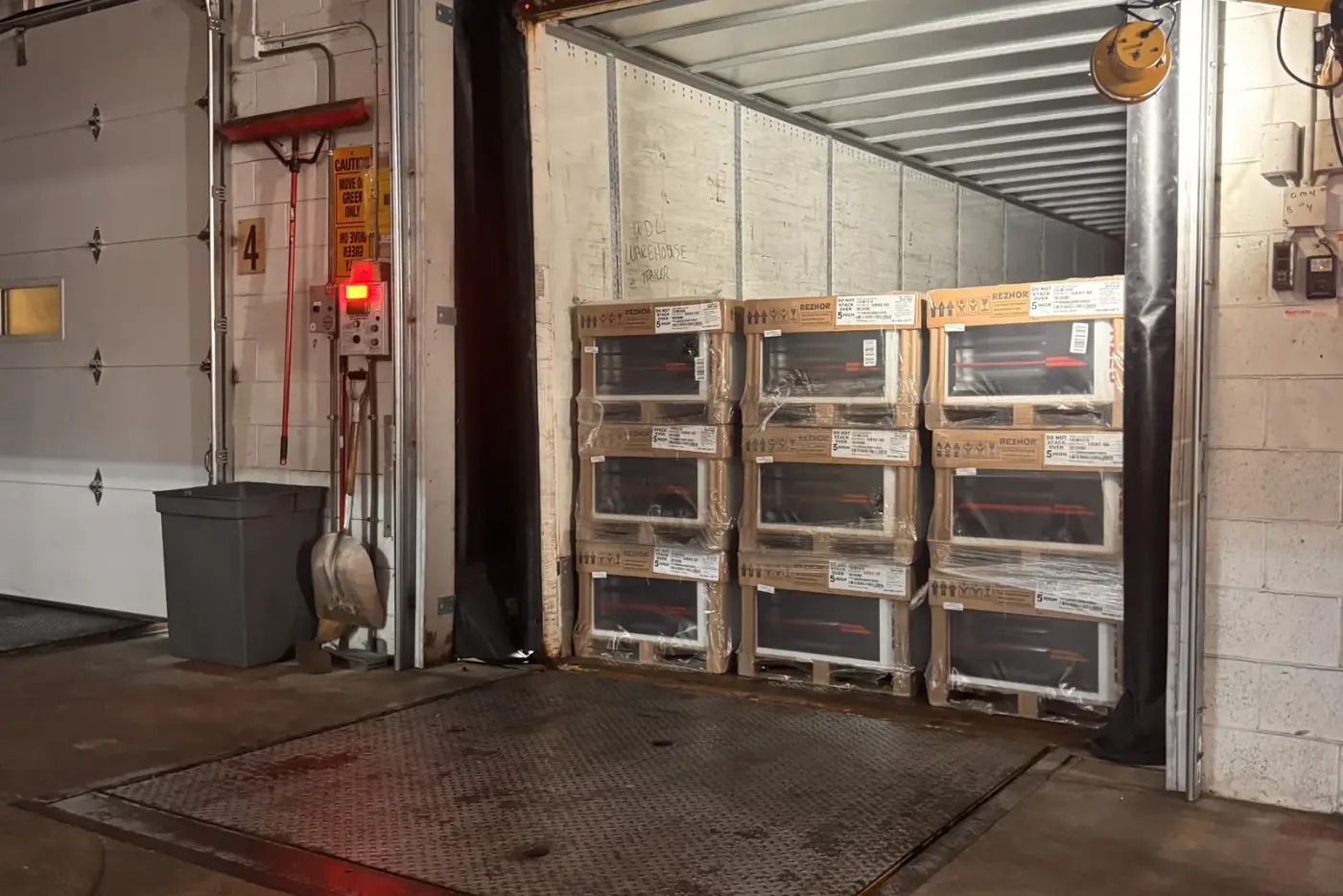
A 53’ dry van holds 26 standard 48-by-40-inch pallets in a single floor layer, loaded straight. Turning the pallets can raise that up to 30 (assuming the pallet is a “4-way” pallet) and a pinwheel pattern reaches 28. Double-stacking can double any of those figures where the freight allows it, but weight usually runs out before space does: a 53’ van tops out around 45,000 pounds of payload.
How many pallets fit in a 53’ dry van?
Twenty-six, floor-loaded straight, using standard 48-by-40-inch pallets. That is the configuration most shippers plan around and the way most skidded freight actually ships.
A 53’ trailer is 636 inches long inside. In a straight load, each pallet sits with its 40-inch side across the trailer and its 48-inch side running down the length. Two pallets side by side use 80 inches of width, and each row consumes 48 inches of length. Divide 636 by 48 and you get 13 full rows. Thirteen rows of two is 26 pallets.
Straight, turned and pinwheeled: how the pattern changes the count
Rotating the pallets changes both numbers in that calculation, which is why the same trailer can hold 26, 28 or 30 depending on nothing but orientation. Note turning pallets can only be accomplished if there is a means to load or unload the pallet in a turned configuration (having a space to slide forklift forks).
In a turned load, each pallet sits with its 48-inch side across the trailer instead. Two of them use 96 inches of width, and each row now consumes only 40 inches of length. Divide 636 by 40 and you get 15 rows. Fifteen rows of two is 30 pallets, four more than a straight load in exactly the same space.
A pinwheel load alternates orientation, fitting pallets around each other in a rotating pattern. It generally lands at 28 and is slower to load, but it can suit freight that will not sit stably in uniform rows.
| Loading pattern | Pallets, single layer | Width used | Trade-off |
|---|---|---|---|
| Straight | 26 | 80 in | Fastest to load, most forklift-friendly |
| Pinwheel | 28 | Varies by row | Slower, needs consistent pallet sizes |
| Turned | 30 | 96 in | Tightest fit, requires pallets to have spots for forks on all sides |
Laufer's dry vans give about 100 inches of usable interior width. The catch will be making sure the weight is still under 45,000 pounds and the pallets are such that can be unloaded from any side.
What are the real dimensions of a 53’ trailer?
Interior dimensions, not exterior, are what freight has to fit inside. Here is what a Laufer dry van gives you.
| Measurement | Laufer 53’ dry van |
|---|---|
| Usable length | 53 ft (636 in) |
| Usable interior width | 100 in |
| Usable interior height | 110 in |
| Exterior width | 102 in |
| Typical payload | ~45,000 lb |
Can you double-stack pallets in a 53’ trailer?
Yes, where the freight supports it, you can double your freight capacity.
Three conditions have to hold. The bottom layer needs a flat, stable top surface that will carry the weight above it without crushing or shifting. The combined height of both layers plus the pallets themselves must clear the interior height, and an empty pallet is around six inches before any freight sits on it. Lastly, the total has to stay inside the weight limit, which is where many double-stack plans can fail.
Light, uniform, sturdy freight double-stacks well. Anything fragile, irregularly shaped, or heavy generally does not, and freight that overhangs its pallet edges will not stack safely at all.
Weight or space: which limit do you hit first?
For most manufacturing freight, weight.
A 53’ van carries roughly 45,000 pounds. Spread across 26 pallets, that allows about 1,730 pounds per pallet before the truck is at its limit. Plenty of freight sits comfortably under that. Palletized steel coils, bagged minerals in supersacks, stamped parts and paper rolls often do not. Loads of these kinds can hit capacity with as little as 8-12 skids or 7 paper rolls, for example.
It is worth knowing before you plan a shipment, that weight will dictate the pallets, as much as space in the trailer does. The untrained eye may see a “half empty truck”, when in reality it’s at its limit.
Gross weight is not the only weight limit
A trailer can be under 45,000 pounds of cargo and still be illegal, because federal limits apply also to axle groups, not only to the total gross weight.
On a van trailer’s tandem axles can carry 34,000 pounds, and the same goes for the drive axles on the truck. The steer axle can have 12,000 pounds for a gross vehicle weight to 80,000. A shipment loaded too far to the front of the trailer, or spread out too far to the back of the trailer can cause an issue with being overweight on an axle group, even if the gross weight is under 80,000 pounds. This is why some freight must be positioned carefully, rather than simply loaded as far forward as the space allows, and why trailer tandems slide.
The practical version for a shipper: Be accurate with your weights and know the correct weight for each pallet, not just the total of the load. Once the driver leaves the shipper, the entire burden of being overweight is their responsibility, and it can turn into a costly mistake.
How many pallets fit on a flatbed, step deck or Conestoga?
Not every palletized load ships in a van, however there are times where shipping palletized product on a flatbed makes sense. One example is when delivering to a jobsite. Often times building materials may be palletized, but the delivery location will not have a dock.
A 53’ flatbed gives the same 636 inches of length and a 102-inch deck width, so the floor space is similar. However, all freight shipping on a flatbed must be chained or strapped down to the trailer. In this scenario height and overhang become a securement concern, not just a space or weight constraint.
A Conestoga is an open deck with a rolling cover over it, so it loads from the side or top like a flatbed and arrives protected like a van. A conestoga can also load from the rear at a dock, like a van. All of Laufer's Conestogas are 53 feet with 104 inches of inside height, against the 96 inches common on many on the road. This is helpful for taller palletized freight, such as machinery which often needs to be side loaded and secured for protection in transit. The trailer types sit side by side if you want to compare the floor space directly.
One example worth naming, because it surprises people: steel coils normally ship on flatbeds, but smaller coils securely banded to pallets do move in dry vans. The pallet count on that load is decided entirely by weight.
What if your pallets are not 48” by 40”?
Pallets come in many sizes outside of the standard. Rough non-stackable skid counts for a 53’ van:
| Pallet footprint | Approximate count, single layer |
|---|---|
| 48 × 40 in | 26 straight, 28 pinwheeled, 30 turned |
| 42 × 42 in | 30 |
| 48 × 48 in | 26 |
| 36 × 36 in | 34 |
Square pallets simplify planning, since rotating them changes nothing. Anything oversized or irregular is worth confirming with the carrier before the truck is dispatched rather than at the dock.
Planning a load with Laufer
The useful conversation is rarely about the pallet count on its own. It is very helpful to our operations team to know pallet count, dimensions and weights, and whether your product is stackable. We’re happy to help figure out the best fit to maximize space and convenience of the loading and unloading process.
Laufer runs 53’ dry vans, flatbeds, step decks and Conestogas out of Hartford, Wisconsin, hauling steel coils, bagged minerals, stamped parts, paper rolls and corrugated products across Wisconsin, Chicagoland and the Midwest. Send us the pallet count and the weights and we will tell you what fits, on which trailer. The full equipment list is here if you want to look first.