Trailer Types: A Complete Guide

08 Jun 2026
The main semi truck trailer types are dry van, flatbed, step deck, Conestoga, and more. Compare specs, uses, and how to choose the right trailer.
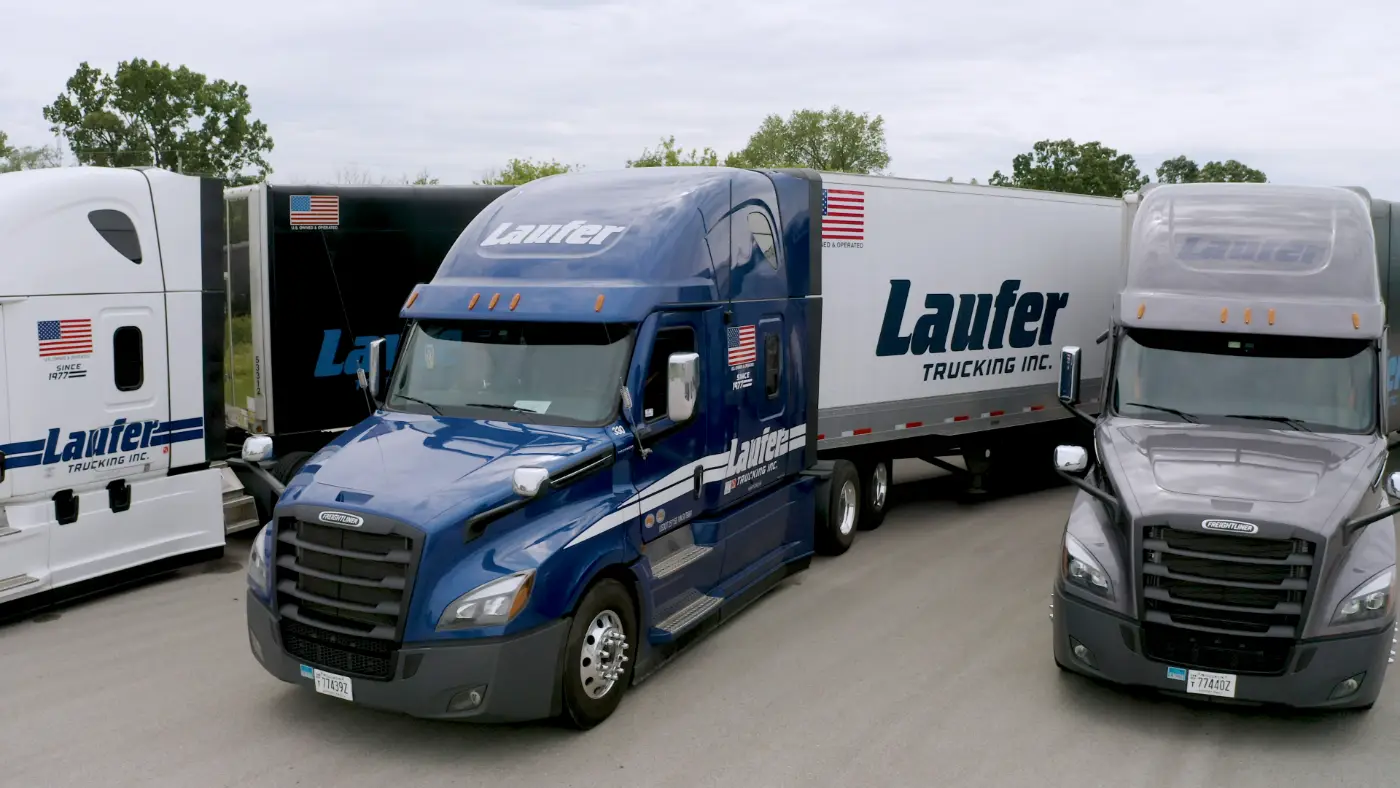
The main semi truck trailer types are dry van, flatbed, step deck, Conestoga, double drop, removable gooseneck (RGN), hotshot, and refrigerated (reefer). Each is built for a different kind of freight, and choosing the right one affects what you can legally haul, how it loads, whether it stays protected from weather, and what the move costs.
This guide walks through every common trailer type, what each is best suited for, and how to decide which one a load belongs on. Laufer Trucking runs four of these types out of Hartford, Wisconsin, so where it helps, we have noted what we actually run and linked to the equipment pages with the full details.
Key takeaways
- There are eight common semi truck trailer types: dry van, flatbed, step deck, Conestoga, double drop, removable gooseneck (RGN), hotshot, and refrigerated reefer.
- Trailer choice comes down to four questions: is the freight enclosed or open-deck, how tall is it, does it need weather protection, and how heavy is it.
- Federal rules cap a loaded tractor-trailer at 80,000 pounds gross and 102 inches wide on interstate highways; height is set by each state, commonly 13 feet 6 inches.
- Dry vans handle the largest share of general freight; flatbeds, step decks, and Conestogas cover open-deck and weather-sensitive loads; double drops, RGNs, and hotshots serve specialized or oversized work.
- Laufer runs dry vans, flatbeds, step decks, and Conestogas, including step deck Conestogas, and focuses on freight that fits within legal trailer dimensions.
What are the main trailer types?
Most freight in North America moves on one of eight trailer types. They divide into three broad families. Enclosed trailers, mainly the dry van and the refrigerated reefer, seal freight inside four walls and a roof. Open-deck trailers, including the flatbed, step deck, hot shots and Conestogas, carry freight that loads from the side or top, or that is too large or awkward for an enclosed trailer. Specialized trailers, such as the double drop and removable gooseneck, handle heavy, tall, or oversized loads that the standard types cannot.
The right trailer type depends on the freight, not the other way around. A pallet of packaged goods belongs in a dry van. A bundle of steel beams belongs on a flatbed. A tall machine that would be over-height on a flatbed belongs on a step deck. Weather-sensitive and difficult to tarp products that still need side loading belong on a Conestoga. The sections below cover each type in turn, with a compact spec reference and what it does best.
What is a dry van trailer?
A dry van is a fully enclosed trailer with a roof, four walls, and rear doors. It is the most common trailer on the road, used for palletized and packaged freight that needs protection from weather but no temperature control: manufactured goods, components, packaged products, and general distribution freight. It loads from the rear, usually by forklift or pallet jack at a dock.
Because the dry van is sealed on all sides, it protects freight from rain, snow, and road debris without any extra handling. That makes it the default choice for the vast majority of freight that moves between manufacturers, distribution centers, and customers. A standard 53-foot dry van holds roughly 26 standard pallets on the floor, which is why shippers plan full-truckload moves around it.
The trade-off is access. A dry van loads only from the rear, so freight has to fit through the doors and down the length of the trailer. Loads that need crane access, that are too wide or tall for the door opening, or that load from the side belong on an open-deck trailer instead. A typical dry van load is a run of palletized packaged goods moving from a Wisconsin plant to a regional distribution center, the everyday work the trailer was built for.
| Spec | Typical figure |
|---|---|
| Length | Up to 53 ft |
| Interior width | Useable approx. 100″ |
| Best for | Enclosed, palletized, weather-protected general freight |
Laufer runs dry vans and special-options vans for specific load configurations, with the everyday capacity most Midwest manufacturing and distribution freight is planned around.
What is a flatbed trailer?
A flatbed is an open deck with no walls and no roof. It carries freight that loads from the side, top, or rear, or that is simply too large or awkward to fit inside an enclosed van: steel, weldments, building materials, and machinery. The open deck allows forklift access from both sides, overhead crane loading, and the chain-and-strap securement that heavy industrial freight requires.
The open deck is the flatbed's whole advantage. A forklift can work either side, or an overhead crane can set a load from above, neither of which is possible inside a dry van. That flexibility is why steel mills, fabricators, and machine shops rely on flatbeds for freight that simply will not go through a rear door.
With that openness comes responsibility. On a flatbed the load is held in place entirely by securement: chains, straps, binders, and blocking, all rated and placed for the specific freight. A bundle of steel beams, a stack of structural steel, or a piece of plant machinery each demands a different securement plan, and getting it wrong means a shifted or lost load. That is why securement is where a flatbed carrier earns its reputation.
| Spec | Typical figure |
|---|---|
| Length | About 48–53 ft |
| Width | About 102 in |
| Best for | Open-deck steel, machinery, and building materials |
Securement is where a flatbed carrier proves its worth. The crews on our open decks treat straps, chains, and blocking as a core skill rather than a formality, which is what steel and machinery freight demands.
What is a step deck (drop deck) trailer?
A step deck, also called a drop deck, is an open trailer with a lower main deck that sits closer to the ground than a standard flatbed. That lower deck is the whole point: it adds vertical clearance so taller freight can ship legally without pushing the total load height over the limit. When machinery or equipment is too tall for a flatbed but still needs open-deck access, a step deck is usually the answer.
The reason this matters comes back to the legal height limit. A standard flatbed sits about five feet off the ground, so once you add a tall machine plus blocking and bracing, the total height can climb past the legal ceiling. A step deck drops its main deck lower, buying back roughly two feet of clearance. That is often the difference between a load that ships as standard freight and one that needs an over-height permit.
A step deck loads the same ways a flatbed does, by forklift from the side, by crane from above, or by ramp for rolling equipment, so it keeps all of the open-deck flexibility. A typical step deck load is a piece of manufacturing equipment that stands too tall to clear on a flatbed but is well within weight and width limits: legal to move, just too tall for the higher deck.
| Spec | Typical figure |
|---|---|
| Decks | Short upper deck + longer lower deck |
| Width | About 102 in |
| Best for | Taller open-deck freight that won't clear on a flatbed |
Laufer runs step decks and step deck Conestogas for tall freight, including tall loads that also need weather protection across long Midwest hauls.
What is a Conestoga trailer?
A Conestoga is a flatbed fitted with a retractable tarp-and-curtain system on a rolling frame. The cover slides along the deck, so freight loads from the side or top like an open flatbed and then seals under cover with no hand-tarping. It combines flatbed-style loading access with enclosed-trailer weather protection in one trailer, which is why it suits high-value or weather-sensitive freight that still needs open-deck loading.
The Conestoga solves a specific problem: how to keep open-deck freight dry without the slow, weather-dependent work of hand-tarping. To load, the driver rolls the cover to one end of the deck, exposing the freight area from the top and sides for forklifts or cranes. Once the load is secured, the cover rolls back over it and latches down. No tarps are unrolled, dragged over the load, or strapped down by hand.
That single design removes two headaches at once. It eliminates hand-tarping, which is the slowest and most physically demanding part of running a flatbed, and it keeps freight out of rain and road spray across long hauls. The trade-off is a small weight penalty for the cover system. For freight like finished steel, high-value machinery, or plastic injection molds, where a wet or torn tarp is not acceptable, that trade-off is easily worth it.
| Spec | Typical figure |
|---|---|
| Length | 53 ft |
| Cover | Retractable tarp-and-curtain system |
| Best for | Weather-sensitive freight needing side or overhead loading |
Laufer runs Conestoga trailers for steel, high-value manufactured goods, and freight that cannot risk a wet or torn tarp on the road.
What is a double drop (lowboy) trailer?
A double drop, often called a lowboy, has a deep well between the front and rear sections, dropping the deck very close to the ground. That extra-low deck lets it carry the tallest freight, such as large construction and industrial equipment, that would be over-height on any other open trailer. The trade-off is a shorter usable deck and a need for specialized loading.
| Spec | Typical figure |
|---|---|
| Deck | Low well between raised front and rear |
| Best for | Very tall, heavy construction and industrial equipment |
Double drops are specialized and often used for oversized equipment. Laufer focuses on freight that fits within legal trailer dimensions and does not run oversized loads that require permits or escorts.
What is a removable gooseneck (RGN) trailer?
A removable gooseneck (RGN) is a heavy-haul trailer whose front section detaches and lowers to the ground, creating a ramp the freight can be driven or rolled onto. Once loaded, the gooseneck reattaches and the trailer is ready to move. RGNs are built for very heavy, self-propelled, or wheeled equipment that cannot be lifted onto a deck.
| Spec | Typical figure |
|---|---|
| Loading | Detachable front forms a drive-on ramp |
| Best for | Heavy, self-propelled, or rolling equipment |
Like double drops, RGNs serve the oversized and heavy-haul niche, which sits outside Laufer's standard scope.
What is a hotshot trailer?
A hotshot trailer is a smaller flatbed-style trailer pulled by a heavy-duty pickup rather than a full semi tractor. Hotshot hauling handles smaller, time-sensitive open-deck loads that do not need a full-size truck. It is a different operating model from full-size trucking, often used for expedited single-pallet or partial loads.
| Spec | Typical figure |
|---|---|
| Tow vehicle | Heavy-duty pickup, not a semi tractor |
| Best for | Smaller, expedited open-deck loads |
Hotshot is a distinct service model. Laufer runs full-size asset-based equipment rather than hotshot rigs. Our brokerage division LT2 Logistics can source hotshot trailer carriers when those are needed.
What is a refrigerated (reefer) trailer?
A refrigerated trailer, or reefer, is an enclosed trailer with a temperature-control unit that keeps freight within a set range. Reefers haul food, beverages, pharmaceuticals, and other temperature-sensitive goods. They look like a dry van from the outside but add insulation and a refrigeration unit, and they cost more to operate.
| Spec | Typical figure |
|---|---|
| Length | 53 ft |
| Feature | Insulated walls + temperature-control unit |
| Best for | Temperature-sensitive food, beverage, and pharma freight |
Reefer is a temperature-controlled specialty. Laufer's enclosed work is dry van, not refrigerated.
How do you choose the right trailer type?
Choosing a trailer comes down to four questions about the freight. First, can it load from the rear or does it require side or overhead loading? Second, how tall is it: will it clear sitting on a standard flatbed, or does it need a lower deck? Third, does it need weather protection: must it stay dry and clean in transit? Fourth, how heavy and how large is it: does it fit within legal dimensions, or is it oversized?
Work through those questions in order and the answer usually narrows to one or two trailers. Enclosed and weather-protected with no temperature need points to a dry van; add a temperature requirement and it becomes a reefer. Open-deck at standard height is a flatbed; too tall for a flatbed moves it to a step deck; weather-sensitive and difficult to tarp but still side-loading points to a Conestoga. Only when the freight is genuinely oversized, too tall, too heavy, or too wide for the standard types, do the specialized trailers come into play.
The most common real-world decisions are not between a dry van and a lowboy; they are between the everyday open-deck options. The table below maps freight characteristics to the trailer that fits.
| If the freight is... | Best trailer type |
|---|---|
| Enclosed, palletized, no temperature control | Dry van |
| Temperature-sensitive | Refrigerated (reefer) |
| Open-deck, standard height | Flatbed |
| Open-deck but too tall for a flatbed | Step deck |
| Open-deck, weather-sensitive and difficult to tarp | Conestoga |
| Very tall, heavy, oversized | Double drop or RGN |
| Small, expedited open-deck | Hotshot |
Two comparisons come up more than any other. Flatbed against dry van against Conestoga is the one shippers weigh most often, and on open-deck freight the cover system is usually what decides it.
What are the legal size and weight limits for trailers?
Federal rules set the outer limits for what a tractor-trailer can carry on interstate highways. A loaded combination vehicle is capped at 80,000 pounds gross weight, including the truck, the trailer, and the freight. The maximum width is 102 inches, which is 8 feet 6 inches. There is no single federal height limit; each state sets its own, and 13 feet 6 inches is the common standard across most of the country.
These limits matter because they decide whether a load moves as standard freight or needs oversize or overweight permits, escorts, and special routing. Axle weight is governed separately by the federal bridge formula, which ties allowable weight to how far apart a vehicle's axles sit. Freight that exceeds the standard limits is legal to move, but only with the right permits and planning.
Gross weight is only half the picture. Even a load under 80,000 pounds total can be illegal if too much of that weight sits over one axle group. Federal rules cap a single axle at 20,000 pounds and a tandem axle at 34,000 pounds, and the bridge formula governs how weight must be spread across the spacing in between. This is why drivers slide trailer tandems forward or back: shifting the axle position redistributes weight to keep each group legal, even when the total has not changed. On a flatbed trailer with a spread axle, you can go to 40,000 lbs on that axle group.
State rules layer on top of the federal baseline, and they vary. Seasonal frost or spring weight restrictions, posted routes, and state-specific axle rules can all change what is legal on a given lane at a given time of year. A carrier that knows the states it runs plans around those rules rather than discovering them at a scale house.
Wisconsin bridge laws and trailer tandem regulations govern how axle spacing, tandem position, and state rules interact to keep a loaded trailer legal.
Which trailer types does Laufer run?
Laufer Trucking is an asset-based, family-owned carrier running four trailer types out of Hartford, Wisconsin: dry vans, flatbeds, step decks, and Conestogas, including step deck Conestogas for tall freight that needs weather protection. We own the equipment, employ the drivers, and dispatch every load from our own headquarters, so the carrier on your rate confirmation is the carrier on the dock.
We focus on freight that fits within legal trailer dimensions, the everyday manufacturing and industrial work of the Midwest: palletized goods, steel and steel coils, machinery, and high-value manufacturing freight. We do not haul oversized loads that require permits or escorts. That focus keeps our equipment, drivers, and schedules aligned with the work we know well.
Our Wisconsin trucking services give a side-by-side view of all four trailer types and what each is best suited for, so you can see where a load fits before you ever pick up the phone.
Get the right trailer for your freight
The fastest way to match a load to the right equipment is to describe the freight to a dispatcher who runs the trucks every day. Call Laufer at (262) 673-6810 with your origin, destination, weight, dimensions, and pickup window, and we will tell you which trailer fits and work the rate from there.