Dry vans, flatbeds and Conestogas: When to Use Each

01 Jun 2026
Dry vans, flatbeds and Conestogas: which trailer fits your freight? Compare loading, weather protection, and cost to choose the right one.
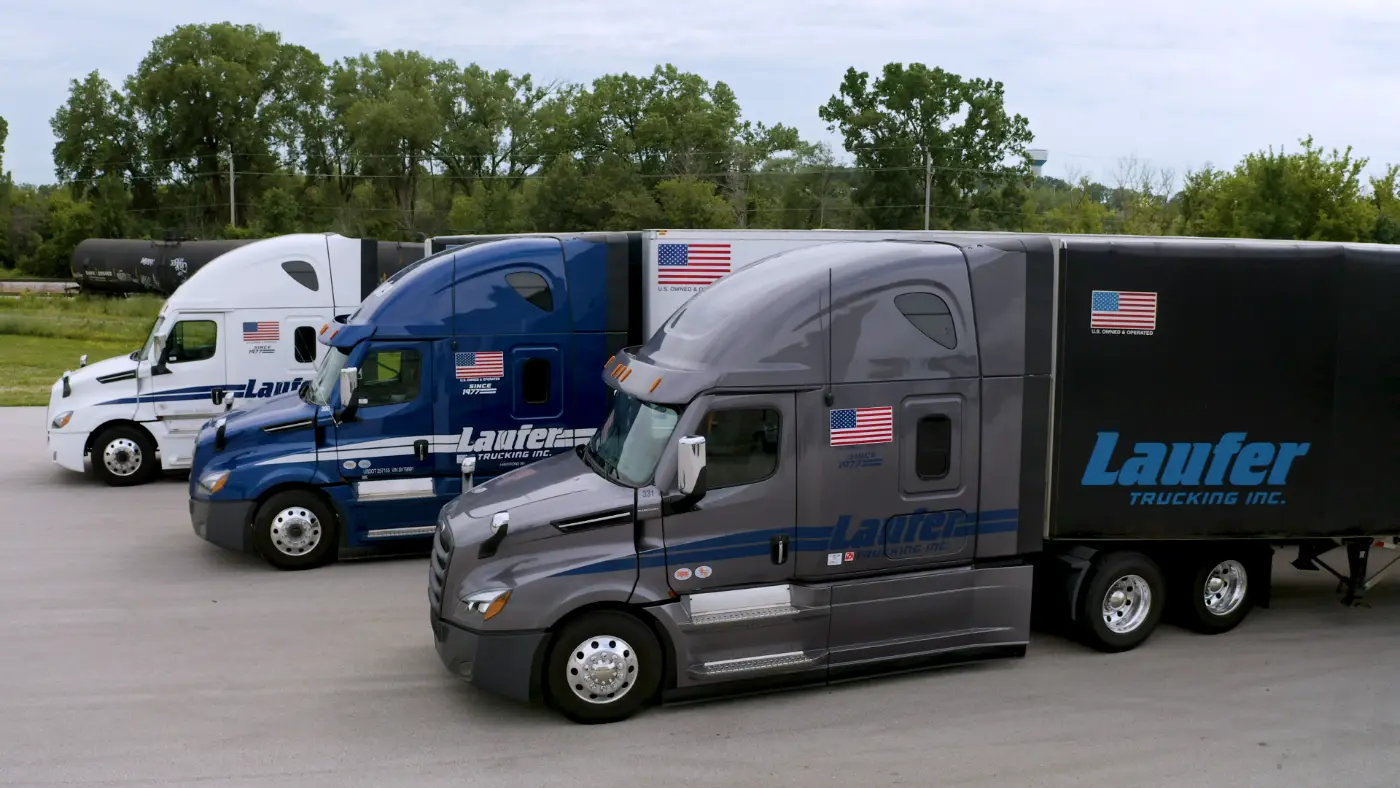
Use a dry van for enclosed, palletized freight that needs weather protection but no special loading. Use a flatbed for open-deck freight that loads from the side or top, like steel and machinery. Use a Conestoga when you need flatbed-style loading plus weather protection, without the time and labor of hand-tarping. The right choice comes down to how the freight loads and whether it has to stay dry.
Those three trailers cover most freight that moves through a Midwest manufacturing economy, and the lines between them are clear once you know what to look at. This guide breaks down when each one is the right call, with a side-by-side comparison and the two head-to-head decisions shippers run into most often. Laufer Trucking runs all three out of Hartford, Wisconsin, so the comparisons below come from operating the equipment, not from listing options on a load board.
Dry vans, flatbeds and Conestogas at a glance
The fastest way to see the difference is side by side. Each trailer answers a different combination of two questions: how does the freight load, and does it need protection from weather?
| Factor | Dry Van | Flatbed | Conestoga |
|---|---|---|---|
| Enclosure | Fully enclosed | Open deck | Open deck with retractable cover |
| Loading access | Rear only | Side, top, and rear | Side, top, and rear |
| Weather protection | Yes | No (tarping if needed) | Yes, under the cover |
| Typical freight | Palletized, packaged goods | Steel, weldments, building materials | Steel, machinery and high-value freight that must stay dry |
| Relative cost | Lowest | Higher | Highest |
| Choose it when | Freight is enclosed and palletized | Freight is open-deck and weather-tolerant | Freight needs open-deck access and protection |
When should you use a dry van?
A dry van is the right choice for enclosed, palletized freight that needs protection from weather but no special handling. It is the default for general manufacturing and distribution freight: packaged goods, components, and palletized loads moving between plants, distribution centers, and customers. If your freight fits on pallets, loads from a dock, and does not need crane or side access, a dry van is almost always the simplest and most economical option.
The limit of a dry van is access. It loads only from the rear, so freight has to fit through the doors over the dock plate and down the length of the trailer. Anything that needs overhead crane loading, that is too wide or tall for the door opening, or that loads from the side belongs on an open deck instead. For the freight a dry van handles best, Laufer's dry van fleet covers the everyday palletized work of Midwest manufacturing.
When should you use a flatbed?
A flatbed is the right choice for open-deck freight that loads from the side or top, or that is too large or awkward for an enclosed trailer. Steel, weldments, building materials, and machinery all ride on flatbeds because the open deck allows forklift access from both sides, overhead crane loading, and the chain-and-strap securement heavy industrial freight requires.
The trade-off is weather. An open deck offers no protection, so weather-sensitive freight has to be tarped by hand, which adds time and handling at the dock. If the freight tolerates the elements, that is no issue; if it cannot get wet or is high value, a flatbed alone might not be the answer. Our open flatbeds handle steel, machinery, and high-value manufacturing freight where securement skill matters as much as on-time delivery.
When should you use a Conestoga?
A Conestoga is the right choice when freight needs flatbed-style loading and weather protection at the same time. It is a flatbed with a retractable tarp-and-curtain cover that rolls back for side or overhead loading, then seals the load under cover. You get the open-deck access of a flatbed plus the protection of an enclosed trailer, without unrolling and strapping down tarps by hand.
That makes the Conestoga the answer for high-value or weather-sensitive freight that still needs to load from the side: finished steel, sensitive machinery, and plastic injection molds that cannot risk a wet or torn tarp or would be very laborious to tarp. The only real trade-off is a small weight penalty for the cover system. Laufer's Conestoga trailers carry exactly this kind of freight across long Midwest hauls.
Flatbed vs dry van: which is right for your freight?
The flatbed-versus-dry-van decision may be multi faceted: does the freight load from a dock or does it require side or overhead loading? Is the freight palletized but too tall to fit through the doors of a van? Is the freight palletized and can fit in a van, but the customer's forklift can't lift it?
If it is palletized and fits through a rear door, a dry van will be the most economical choice. If it loads by crane or forklift from the side, or it is too large for an enclosed trailer, a flatbed is the only one of the two that works.
Weight and dimensions rarely settle this choice on their own, because both trailers carry similar legal loads. What settles it is access and protection. Enclosed and palletized points to a dry van; open, oversized, or crane-loaded points to a flatbed. When the freight is open-deck but also needs to stay dry and tarping might be a challenge, a Conestoga is probably the best bet.
Cost and loading time also factor in. A dry van is usually the least expensive of the three to run and loads quickly at a standard dock, which is part of why it dominates general freight. A flatbed will cost more once securement and any tarping time are accounted for, but for freight that genuinely needs open-deck access there is no cheaper alternative that actually does the job. The mistake to avoid is shipping freight in a van and finding out it cannot be unloaded on the other end due to dock or forklift limitations, or conversely paying for an open deck when a van would have carried the load for less.
Conestoga vs flatbed: when is the tarp worth it?
When a Conestoga is requested it generally costs more than a regular flatbed and carries a little less because of the cover system. The higher cost associated with Conestogas is due to the higher purchase price, higher cost to maintain and the extra care and training required to have a driver qualified to operate the equipment.
The question is whether the load is practical to ship on a flatbed. Some freight that requires weather protection is too oddly shaped, has sharp edges or is too valuable to tarp.
The Conestoga earns its place when hand-tarping is slowing your dock down, when the freight cannot risk a wet or torn tarp, or when it needs to stay clean and out of road spray over a long haul. Finished steel headed to a customer, high-value machinery, and weather-sensitive manufacturing freight all justify the cover. Weighing the two specifically for steel is its own question. The full case for a Conestoga sits on its own page.
There is an efficiency argument too. Hand-tarping a flatbed load can add significant time at both ends of a haul, and it is weather-dependent and physically demanding work. A Conestoga removes that step entirely: the driver only needs to open, move and close the curtain unit to cover the load. For a shipper moving regular weather-sensitive freight, faster dock turns and fewer weather delays can outweigh the modest cost of the cover system over the course of a year.
How Laufer compares the three from experience
Because Laufer runs dry vans, flatbeds, and Conestogas out of one Hartford terminal, the choice is rarely about what is available and usually about what fits the freight best. Palletized general freight goes in a dry van. Steel and machinery that tolerate the weather go on a flatbed. Steel, molds, and high-value goods that must stay dry and are challenging to tarp, but still load from the side go on a Conestoga. The same dispatcher can talk through all three because the company owns and runs all three.
That is the practical advantage of an asset-based carrier over a broker: the recommendation is grounded in the equipment actually in the yard, not in whatever capacity is available at any given time. All five trailer types Laufer runs are set out side by side.
Match your freight to the right trailer
The quickest way to settle which trailer fits is to describe the freight to a dispatcher who runs all three every day. Call Laufer at (262) 673-6810 with your origin, destination, weight, dimensions, and pickup window, and we will tell you whether it belongs in a dry van, on a flatbed, or under a Conestoga, and work the rate from there.