What's a Conestoga, and Why Are Laufer's Different?

11 May 2026
A conestoga is a flatbed with a retractable cover for side, top, and crane loading without hand-tarping. See when to use one — and why Laufer's are spec'd taller than the industry standard.
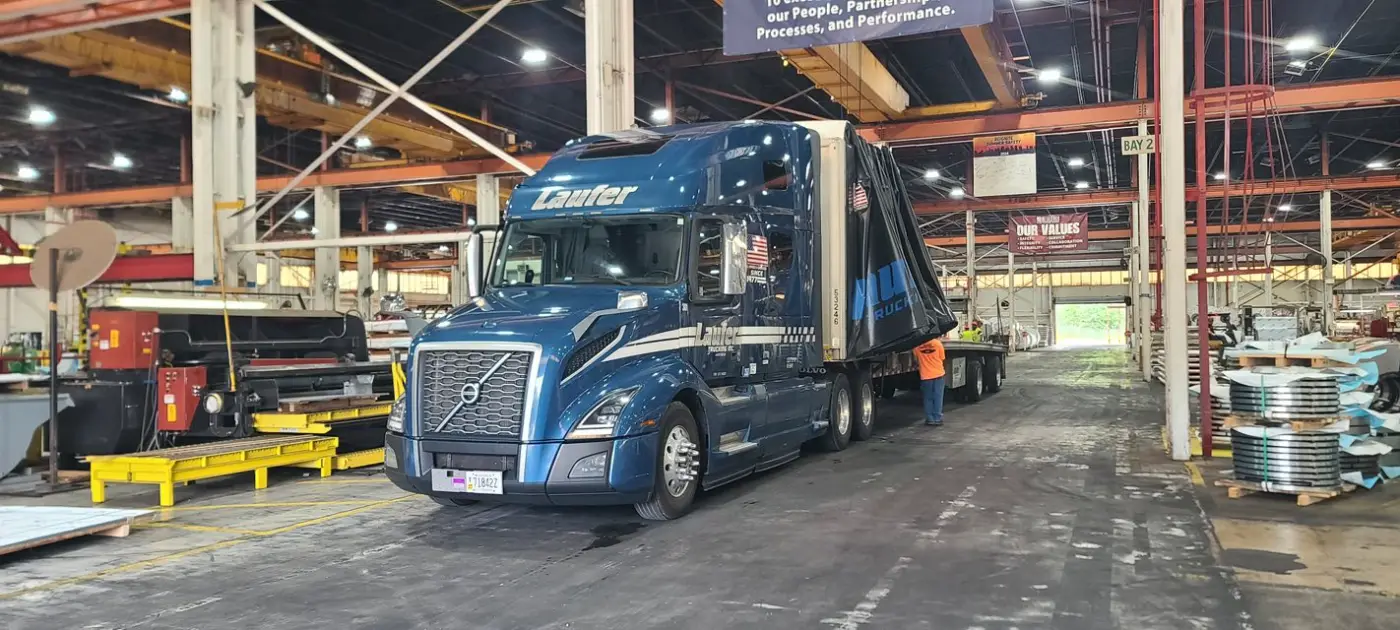
A conestoga is a flatbed with a retractable tarp system that rolls to the front or back of the trailer. It can be loaded from the side, with a crane, or from the rear — without hand-tarping. See when to use one and why Laufer''s conestogas are different than the standard.
Its value is simple: you get the side and overhead loading of an open flatbed plus protection from weather, without the often highly laborious task of tarping. It is the right trailer when freight needs open-deck access and has to stay dry at the same time. It''s also a great choice for items that are difficult to tarp due to shape and size, or of high value, when padding and tarps touching the product could cause damage.
If you are deciding whether a conestoga trailer fits your freight, the questions that matter are how the load needs to be handled, whether it can tolerate weather, and how often hand-tarping is slowing your dock down. This guide walks through how the trailer works, when to choose it over a plain flatbed, and what freight it suits best. Laufer Trucking runs conestogas, including step deck conestogas, out of Hartford, Wisconsin.
Is a conestoga the same as a curtain side trailer?
No, even though the terms are often used interchangeably. Technically a curtain side trailer is one that has a hard top that does not move and curtains that drop down on each side. Curtain sides can only be side-loaded, not crane-loaded.
The term "conestoga" started with a link to the historical covered-wagon "Conestoga" apparatus of the pioneer days, invented in Conestoga Valley, PA. The original manufacturer of this type of trailer named it the Conestoga, and — much like "Kleenex" — the term became the standard for the product.
How does a conestoga trailer work?
The cover rides on a frame of bows and tracks that runs the full length of the trailer. To load, the driver rolls the cover to one end of the deck, which exposes the freight area from the top and both sides. Forklifts can work either side and an overhead crane can set a load from above, exactly as they would on an open flatbed. Once the freight is properly secured, the cover is rolled back over the load and locked into place, providing protection from weather and road debris throughout transit.
That design is what separates a conestoga trailer from both a regular flatbed and an enclosed van. A flatbed offers the same open-deck access but no protection, so weather-sensitive freight must be tarped by hand. A dry van offers protection but loads only from the rear. The conestoga is the one piece of equipment that does both, which is why it suits freight that is awkward to load and tarp.
There is a modest trade-off. The cover system adds weight, reducing overall capacity slightly. Laufer''s conestogas can haul up to about 46,500 lb.
When should you use a conestoga instead of a flatbed?
Choose a conestoga when freight needs open-deck loading and weather protection at the same time. If a load could ride on a flatbed but cannot risk rain, road spray, or a torn tarp, the conestoga cover solves the problem without the labor of hand-tarping. If hand-tarping is regularly slowing your dock down, the time saved over many loads can outweigh the trailer''s modest extra cost.
A plain flatbed can still be the better choice when freight tolerates the weather, because it may be less expensive to source and can carry a little more weight. The decision is not about capability, since both load the same way, but about whether protection is worth the cover system''s cost and weight. A useful rule of thumb: if you would tarp the load on a flatbed anyway, a conestoga is probably worth it; if the load would ride open and uncovered, a flatbed could be a less expensive option. For the full cost-and-protection breakdown across all three common trailers, our comparison of when to use a flatbed vs dry van vs conestoga lays it out side by side.
What freight is a conestoga trailer best for?
A conestoga trailer is best for high-value or weather-sensitive freight that still needs to load from the side or top. This can include weldments, sensitive machinery, and injection molds, or a variety of steel shipments. These are loads where a wet or torn tarp is not acceptable and where the freight is too large or awkward to ride inside a dry van.
It is also the right call when a load needs to stay clean or out of public view in transit, or when the receiving dock cannot accommodate the time and space of hand-tarping. Laufer''s conestoga trailers carry exactly this kind of protected, open-deck freight across long Midwest hauls. For steel specifically, where weather protection and securement both matter, our guide to the best trailer for hauling steel goes deeper on the choice.
Why are Laufer''s conestogas different?
Laufer chooses to spec our conestogas at a higher than standard configuration. The majority of conestogas on the road are only 96" tall on the inside; ours are all 104". That accommodates taller freight, which is especially useful for our customers. All of our conestogas are 53'' long as well.
What is a step deck conestoga?
A step deck conestoga combines the lower deck of a step deck trailer with the same retractable cover as a standard conestoga. It carries taller freight that needs both extra vertical clearance and weather protection — without hand-tarping and without losing side-load access. It is a specialized piece of equipment that most regional carriers do not run, but for the right freight it turns what could be a complicated and labor-intensive tarping job into a shipment that is much easier and safer to keep protected. Laufer''s step deck conestogas accommodate up to 118" of height on the lower deck.
The step deck conestoga earns its place when a load is too tall to clear inside a standard conestoga but still belongs under cover: tall steel fabrications, high machinery, and similar protected freight. Laufer''s step decks and step deck conestogas handle exactly that combination of height and protection. For how the lower deck buys back legal height, the broader guide to semi truck trailer types covers step decks in full.
Why Laufer runs conestogas
We believe conestoga trailers bring value to our customers — especially the taller-than-standard heights our trailers accommodate. And we believe they bring value to our drivers, saving them the time and extensive effort often involved with tarping.
Get a conestoga trailer quote
If your freight needs open-deck loading and has to stay dry, a conestoga is likely the right fit. Call Laufer at (262) 673-6810 with your origin, destination, weight, dimensions, and pickup window, and we''ll confirm whether a conestoga or step deck conestoga suits the load and work the rate from there.